

Australia: The Reluctant ElectroState
Australia is building an ElectroState while pretending it is not.

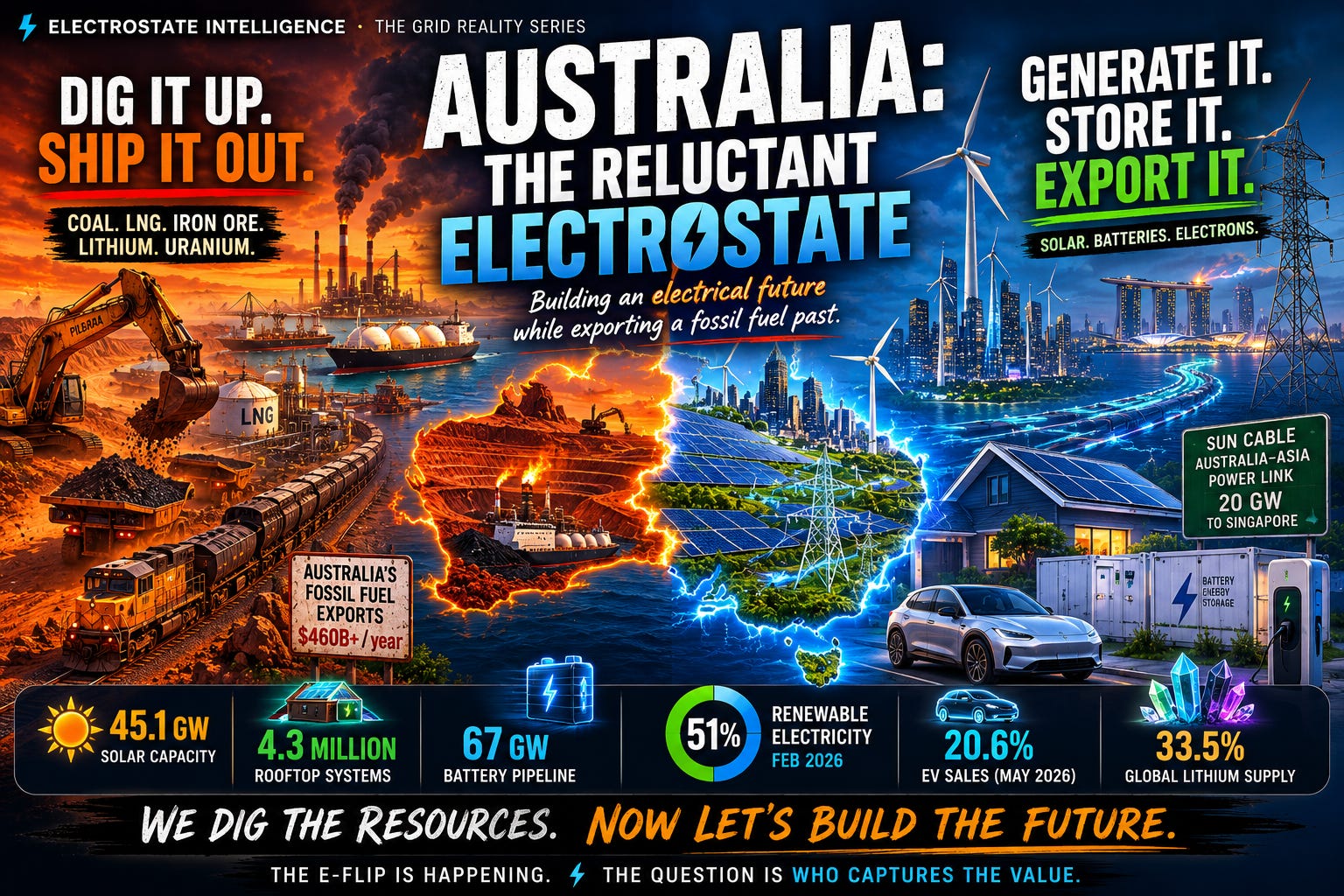
The country is the world’s third-largest fossil fuel exporter. It ships coal to Japan, LNG to China, and uranium to whoever will buy it. Its political class has spent two decades arguing about whether climate change is real, whether renewables are reliable, and whether coal miners deserve more protection than the Great Barrier Reef. In 2017, Australian Treasurer (later Prime Minister) Scott Morrison famously brought a lump of coal into Parliament to accuse the opposition Labour Party of “Coalophobia” by declaring ”This is coal. Don't be afraid. Don't be scared. This is the bedrock of the Australian Economy". The culture wars around energy in Australia have been as bitter as anywhere on earth.
And yet. One in three Australian homes now has rooftop solar, 4.3 million installations, 28.3 GW of capacity. The country has 45.1 GW of solar in total, in a nation of 27 million people. Per capita, that is one of the highest levels of solar penetration on the planet. In February 2026, renewables supplied 51% of electricity in the National Electricity Market for the first time. Coal generation hit a record quarterly low. Gas generation fell 24% year on year.
Australia did not plan this. Australians did it anyway.
The Rooftop Revolution
The story starts on the roof. Australia’s residential solar fleet is unlike anything in Europe or North America. At 28.3 GW, it is larger than the entire electricity generation capacity of many European countries. The economics are straightforward: Australian electricity prices are high, Australian sunshine is abundant, and the payback period on a rooftop system in most of the country is three to five years. No ideology required. Just arithmetic.
Home batteries are following the same trajectory. The Clean Energy Regulator projects 520,000 residential battery installations in 2026 alone, adding up to 12 GWh of behind-the-meter storage. Australians are not waiting for a grid-scale storage policy. They are buying their own.
Big Batteries
But the grid is catching up. In 2025, Australia commissioned 1.9 GW and 4.9 GWh of grid-scale battery capacity — matching the total installed between 2017 and 2024. In a single year, the country doubled its cumulative large-scale battery fleet. There are now 75 storage projects either financially committed or under construction, representing 13 GW and 34.7 GWh. The total pipeline of projects at various stages of development has reached 67.3 GW. Australia is the world’s third-largest utility battery market, behind only the US and China.
The battery build is not decorative. It is closing the coal plants, Yallourn in 2028, Eraring in 2029, with no replacements being built, the batteries and solar are filling the gap. For the black coal of New South Wales and Queensland, solar plus batteries are already cheaper than the short-run marginal cost of coal (SRMC). For brown coal in Victoria, it is not yet on a pure SRMC basis, but it will be soon. Every quarter, coal’s share of generation drops. Every quarter, the share of renewables rises. The crossover happened in February 2026. There is no mechanism to reverse it. This is why 75% of Australia’s coal fleet is expected to close by 2035.
EVs: Late but Fast
Australia came late to electric vehicles. As recently as 2023, EV market share was below 5%. But the acceleration has been sudden and steep. In May 2026, EVs accounted for 20.6% of new car sales, double the share in the same month a year earlier. Combined with plug-in hybrids and conventional hybrids, electrified powertrains now account for 38.6% of all vehicles sold in Australia.
The drivers are familiar. BYD, MG, and GWM have pushed EV prices below A$40,000. Chinese manufacturers did to the Australian car market what Chinese solar manufacturers did to the electricity market: they made the technology so cheap that policy became irrelevant. Australia had no EV mandate, no fleet standard until recently, and minimal public charging infrastructure. The cars sold anyway.
Gas Bans and Heat Pumps
The states are moving faster than the Federal Government. Victoria banned gas connections in new homes in 2024. From March 2027, when a gas hot water system in an existing Victorian home fails, it must be replaced with an electric alternative. New South Wales followed — the City of Sydney mandated all-electric systems in new residential builds from January 2026. Gas cooktops, ovens, heating, hot water: all banned in new construction.
The economics support the policy. A heat pump hot water system retails at A$3,000–4,500, but after stacked federal and state rebates, the net cost falls to A$440–1,240. Annual running costs: A$120–250, lower again with rooftop solar. The gas network is becoming a stranded asset in slow motion. Every house that disconnects shifts the fixed costs of maintaining the pipes onto the remaining customers. The death spiral is underway.
The Quarry Problem
Australia is the world’s largest lithium producer, accounting for 33.5% of global output in 2025. It has significant reserves of cobalt, rare earths, nickel, and manganese. Every battery chemistry the world is scaling requires minerals that Australia digs out of the ground.
But Australia ships ore. It does not, for the most part, process it. Lithium ore exports generate roughly A$800–1,200 per tonne. Lithium carbonate commands A$18,000–28,000 per tonne. The value multiplication from processing is a factor of fifteen to twenty. And almost all of that processing happens in China.
This is the quarry problem. Australia sits on the raw materials of the E-Flip and exports them at commodity prices, then imports the finished products, batteries, EVs, and solar panels at the value-added, manufactured prices. It is the same structural position Australia has occupied for two centuries with wool, iron ore, and coal: dig it up, ship it out, buy the finished goods back.
The government has recognised this. The Critical Minerals Production Tax Incentive offers a 10% offset for eligible processing and refining. The A$4 billion Critical Minerals Facility provides project financing. But the gap between policy aspiration and industrial reality remains wide. China dominates midstream processing, the separation, refining, cathode and anode production and that dominance did not happen by accident. It happened through sustained industrial policy over fifteen years. Australia is starting that race very late.
The Export Paradox
Here is the tension at the centre of Australia’s ElectroState pathway. Domestically, the transition is happening faster than almost anyone predicted. Rooftop solar, big batteries, EVs, gas bans, that momentum is real and largely irreversible. But Australia remains the world’s largest coal exporter and third-largest LNG exporter. The revenue from those exports funds the federal budget, employs regional communities, and shapes the political economy of entire states.
Australia is building an ElectroState at home while exporting fossil fuels. That contradiction will not hold forever. As Asian importers electrify — as Korea builds its own ElectroState, as China’s oil demand contracts, as Japan and India follow — the export markets for Australian fossil fuels will shrink. The question is whether Australia builds the replacement export industries fast enough.
SunCable offers one answer. The Australia-Asia Power Link, a 20 GW solar farm in the Northern Territory connected to Singapore via a 4,300 km HVDC submarine cable, would make Australia an electricity exporter. Not a coal exporter. Not an LNG exporter. An electron exporter. The first power to Darwin is planned for the early 2030s, with Singapore following in the mid-2030s. Green hydrogen and ammonia offer another pathway: the Murchison project in Western Australia targets 1.9 million tonnes of green ammonia per year for Asian markets.
These are not fantasies. They are projects with financing, approvals, and timelines. But they are also a decade away from full operation, and Australia’s coal and gas exports generate revenue today.
The Pathway
Australia’s ElectroState pathway differs from those of Korea and Spain. It is not being driven primarily by the Federal Government strategy. It is being driven by economics and by citizens acting in their own financial interest. Australians install solar because it saves money. They buy EVs because the Chinese imports are cheap. They switch to heat pumps because they also cool. State governments are banning gas because network economics no longer justify maintaining it.
The federal government is, for the most part, running to keep up with what is already happening. The 82% renewable electricity target by 2030 looked ambitious when it was set. At 51% in February 2026, with coal in structural decline and battery deployment accelerating, it now looks achievable — not because of government action, but because the cost curves have done the work.
What Australia still lacks is an industrial strategy to match. The minerals are there. The solar resource is arguably the best in the developed world. The land is there. But the processing capacity, the manufacturing base, and the export infrastructure for an electrical economy are not. Australia has the raw ingredients of an ElectroState. It has not yet decided to build the kitchen.
The countries that control Electrotech manufacturing will set the terms of the next energy order. Australia can be one of them; it has the geology, the geography, and the capital to process its own minerals, manufacture its own batteries, and export clean energy to Asia. Or it can remain a quarry: shipping rocks to countries that turn them into the technologies of the future, then buying those technologies back at retail.
The E-Flip is happening in Australia, whether the political class acknowledges it or not. Now the question is whether Australia captures the industrial value of that flip, or just the mining royalties.
Gradually, Then Suddenly.
end
Nadim Chaudhry is the author of ElectroState: How the Electrification E-Flip, China, Geopolitics will Reorder the Global Economy, examining the global transition from fossil fuels to electrification through geopolitical and systems lenses.
ElectroState.com offer premium intelligence services and consulting for the electrical energy transition
Subscribe for free to receive the latest analysis. Premium intelligence briefing service available at ElectroState.com