

The Quiet Revolution: How Industrial Heat Pumps Will Eat the Gas Market
One Temperature Band At A Time

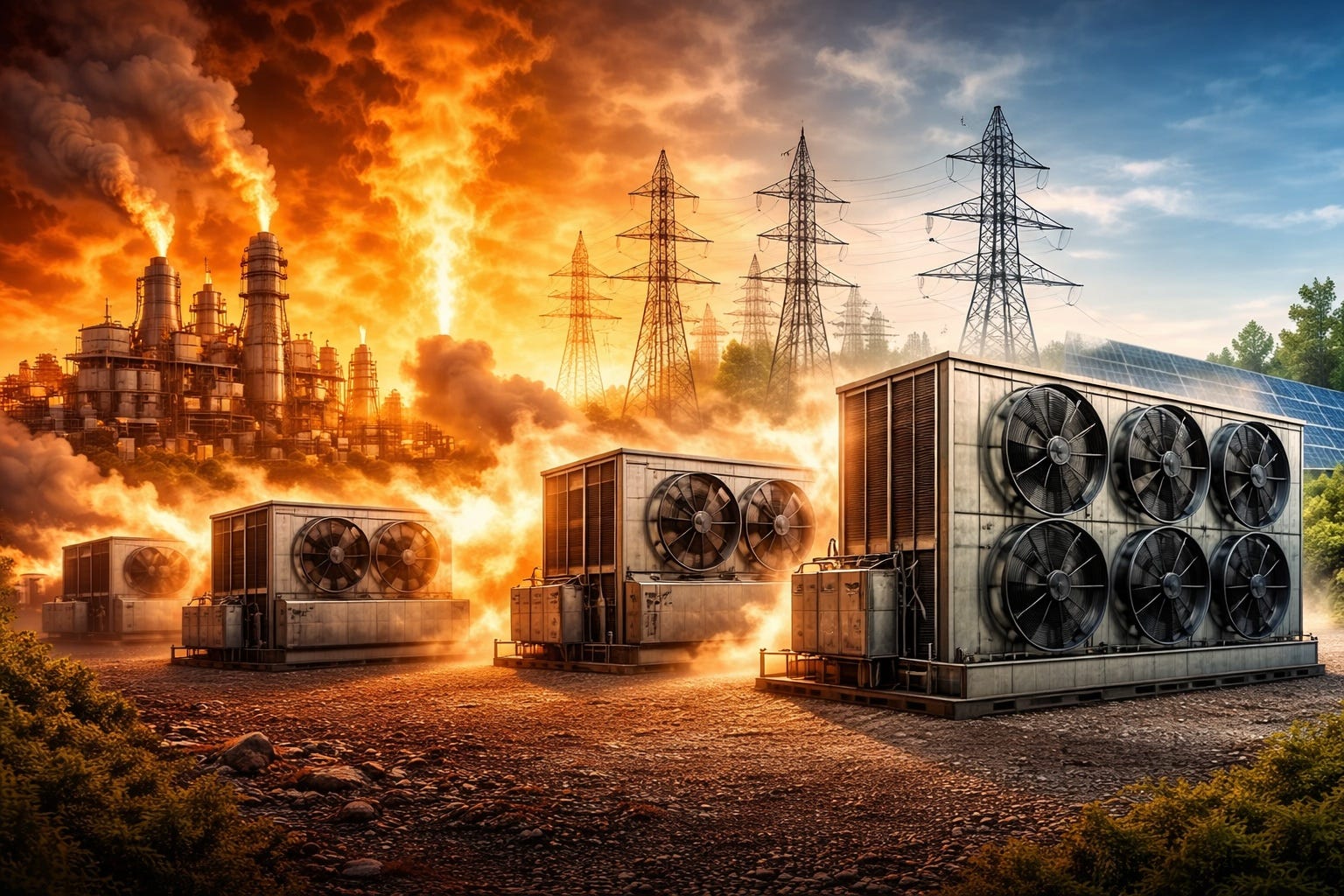
Industrial heat is the elephant in the room of the energy transition. It accounts for roughly 100 exajoules of global final energy demand, around a quarter of all energy consumed on Earth. Most of that heat is still produced the way it was a century ago: by burning fossil fuels, principally natural gas.
The conversation about electrification tends to focus on the visible stuff: EVs, rooftop solar, residential heat pumps. Important, all of it. But the industrial heat market is where the real structural shift in gas demand will play out. And it is playing out, right now, in three overlapping phases that most energy analysts are still treating as a sideshow.
They should not be. The numbers are enormous.
Heat is not just an Energy Problem — it is a Systems Integration Problem
Before getting into the phases, it is worth understanding why heat has been so slow to electrify, and why that is about to change.
In ElectroState, I describe heating as the largest untapped control surface in the energy system. It is one of the most significant sources of demand and emissions, yet it sits poorly within the existing electrical system. In most countries, gas networks and oil delivery trucks operate independently of the electricity grid, with minimal coordination between the three systems. Heating has a separate supply chain and inflexible infrastructure.
Electrification eliminates this duplication. When heat is electric, it becomes controllable, schedulable, and responsive to grid conditions. Industrial processes already operate with buffers, scheduling windows, and tolerance for variation. Aluminium smelters can modulate load. Cement kilns have inherent thermal storage. Cold-storage warehouses can pre-cool. Electric furnaces, electrochemical processes, and digitally controlled equipment can respond rapidly to system conditions, which adds considerable flexibility.
This matters because it transforms one of the most stubborn sectors of the energy system into a stabilising force. Heat stops being a passive, inflexible consumer and becomes an active participant in the grid. The value is not just in swapping the fuel. It is in bringing an enormous source of demand into the electrical system, where it can be better managed.
The Three-Phase Advance
Think of industrial heat electrification not as a single technology deployment but as a campaign advancing through temperature bands — each one unlocking a new tranche of gas demand for displacement.
Phase 1: Below 100°C — The Beachhead (Already Established)
This is the territory where electric heat pumps are already proven, commercially mature, and economically competitive in many markets. Processes in the food and beverage, pharmaceutical, textile, and chemical industries routinely require heat at 60–90°C. At these temperatures, modern heat pumps achieve coefficients of performance (COP) of 3.0 to 4.0, meaning they deliver three to four units of useful heat for every unit of electricity consumed.
Compare that with a gas boiler operating at 85–90% thermal conversion. The heat pump does not just replace the boiler. It slashes the primary energy required to do the same job by a factor of three. This is what I call the primary energy fallacy in reverse: when analysts compare energy systems by primary energy inputs rather than useful energy outputs, they systematically overstate the scale of renewable deployment needed. A heat pump delivering 3 kWh of heat from 1 kWh of electricity is not “consuming less energy.” It is doing the same work with radically less waste, and thus, the task of electrification is smaller than primary energy statistics make it look.
This temperature band alone represents around 15 exajoules of global industrial heat demand. Roughly half of that is currently supplied by natural gas, equivalent to over 200 billion cubic metres (bcm) of gas per year. For context, that is more than the combined gas consumption of Germany and France.
The technology is mature. The economics work in most European and many Asian markets. The constraint is not physics. It is the regulatory and pricing environment, the spark gap between electricity and gas taxation, that I have written about extensively. Fix the price signal, and adoption in this band speeds up sharply.
Phase 2: 100–150°C — The Scaling Frontier (Underway)
This is where things get interesting. Processes in paper and pulp, plastics manufacturing, district heating networks, and parts of the chemical industry require heat in the 100–150°C range. Until recently, heat pumps could not reliably deliver at these temperatures. That has changed.
New compressor designs, particularly from manufacturers like Danfoss, whose semi-hermetic Turbocor series now handles working fluids up to 150°C, have pushed the technology frontier decisively into this band. COPs of 2.5 to 3.0 are achievable, still vastly better than combustion on a primary energy basis.
This band represents a further 12 exajoules of heat demand and around 150 bcm of gas consumption globally. Deployment is scaling: industrial heat pump installations in this range are growing at roughly 8–10% per year, and China’s recent policy push to expand heat pump deployment in light industry will likely steepen that curve.
Phase 3: 150–200°C — The Emerging Frontier (Early Deployment)
This is where the excitement and the scepticism concentrate. Processes in refining, heavier chemicals, mineral processing, and some food applications require heat above 150°C. Heat pumps operating at these temperatures are real, but in their early stages. Mitsubishi Electric has launched a 160°C-capable air-to-water system using CO2 refrigerant, achieving a COP of 3.1 even in sub-zero ambient conditions. European start-ups such as Heaten are demonstrating units capable of operating at 200°C.
COPs in this band are lower, typically 2.0 to 2.5, but still represent a dramatic improvement over gas combustion in terms of primary energy use. The addressable gas demand is another 110 bcm globally.
This is the phase in which the growth curve is most likely to bend sharply upward over the next decade, once electricity-to-gas price ratios improve, carbon pricing bites harder, and manufacturing at scale brings capital costs down.
The Gas Displacement Arithmetic
Run the numbers across all three phases, and the picture is striking.
Industrial heat demand below 200°C totals roughly 35 exajoules. About half of that, around 17.5 EJ, is currently supplied by natural gas, equivalent to approximately 480 bcm. That is around 12% of total global gas consumption.
Displacing that gas through heat pumps would require roughly 1,400 TWh of additional electricity, about 5% of current global generation. A significant but entirely manageable increment, particularly as renewable capacity continues to expand at over a trillion dollars of investment per year.
For the EU specifically, the figures are even more significant proportionally. Around 25% of EU gas consumption goes to industry, and roughly half of that industrial gas demand is used for heat processes below 200°C. That equates to about 40 bcm of gas that could be displaced, over 12% of total EU gas consumption. In a continent still rebuilding energy security after the disruption of the Russian pipeline and the Iranian War, that is not a marginal number. It is strategically significant.
And remember: because heat pumps operate at COPs of 2–4, you do not need to replace each unit of gas energy with a unit of electricity. You need a third to a half as much. Electrification of heat does not just swap the fuel. It shrinks the total energy the system requires. This is the core insight of the ElectroState thesis: electrons are more useful carriers of work than molecules. Every sector that electrifies reduces its total primary energy demand.
Why the Curve will Bend?
Right now, growth in industrial heat pumps is steady and linear, at roughly 5–7% per year for industrial units specifically. That looks modest. But the conditions for a steeper trajectory are assembling.
First, the electricity-to-gas price ratio is trending in the right direction. As renewable penetration rises and grid flexibility improves, wholesale electricity costs are falling structurally. Meanwhile, carbon pricing, particularly the EU’s ETS2 from 2027, which will extend carbon costs to heating fuels, will raise the cost of the gas alternative.
Second, high-temperature heat pump technology is maturing rapidly. The progression from 80°C to 100°C took years. The jump from 100°C to 150°C is happening now. The push from 150°C to 200°C and beyond is in active commercial development. Each temperature threshold crossed opens a new segment of industrial demand.
Third, the policy environment is shifting. The EU’s Energy Taxation Directive, unchanged since 2003, taxes fuels by volume rather than energy content, which systematically undertaxes gas relative to electricity. The revision is overdue, and the Commission’s 2025 Affordable Energy Action Plan has flagged lower electricity taxation as a priority. When that spark gap closes, the economics of industrial heat pumps improve immediately across every temperature band.
Fourth, and perhaps most importantly, the learning curve has not flattened. Industrial heat pumps are where residential heat pumps were a decade ago: proven in principle, but not yet manufactured at the scale that drives costs down the experience curve. As deployment volumes rise, capital costs will fall, installation expertise will deepen, and system integration will become routine.
What does this mean?
Industrial heat electrification is not a niche. It is a structural threat to gas demand on a scale that the gas industry’s own projections consistently underestimate, because those projections tend to assume that industrial heat is “hard to electrify” without examining the temperature distribution that tells a more nuanced story.
The obstacles that remain are not technical but institutional. Heating sits outside traditional electricity markets and policy frameworks, which leads to poor system design. Until regulators treat heat as part of the electricity system rather than a separate domain, its capacity as a grid control surface, and its capacity to displace gas, will remain underused.
Below 200°C, the physics works, the technology exists, and the economics are either already favourable or will become so once policy aligns. That covers over a third of all industrial heat demand and around 12% of global gas consumption. It is not a rounding error but a market that is about to move.
The question is not whether industrial heat will electrify. It is how fast, and whether Western manufacturers and policymakers will lead that shift or find themselves buying the equipment from those who did.
Nadim Chaudhry is the author of ElectroState: How the Electrification E-Flip, China, Geopolitics will Reorder the Global Economy, examining the global transition from fossil fuels to electrification through geopolitical and systems lenses.
ElectroState.com offer premium intelligence services and consulting for the electrical energy transition