

Think Slow, Build Slow...
Why Europe's Electricity Industry Is Sleepwalking Into Its Own Revolution

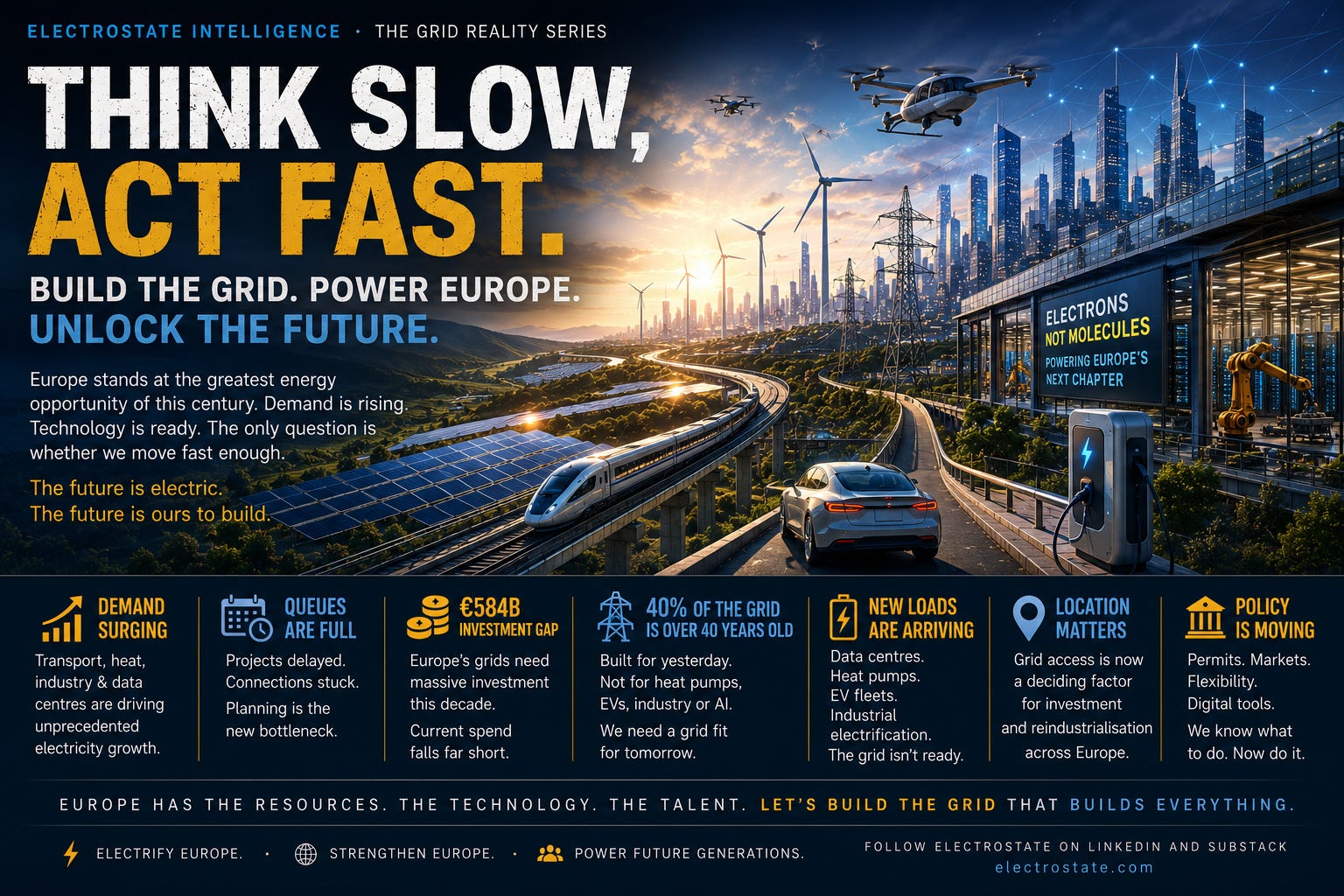
I returned last week from the excellent Eurelectric Power Summit in Helsinki. The agenda was packed with political leaders, geopolitical thinkers, utility executives and energy analysts, from President Alexander Stubb of Finland to Rory Stewart and Alastair Campbell of The Rest is Politics, Michael Lewis, CEO of Uniper, Professor Jan Rosenow and Kingsmill Bond. I arrived expecting to find an industry quietly confident that its moment had finally arrived. After all, if the world is entering a period of rapid electrification, then Europe’s electricity industry should be one of the greatest beneficiaries. Transport is electrifying. Heating is electrifying. Industry is beginning to electrify. Artificial intelligence and data centres are increasing the demand for power. For the first time in decades, electricity demand growth is returning. Surely this should be an industry rubbing its hands with anticipation.
Instead, I came away with a very different impression. The mood was not one of confidence but one of frustration. Conversations repeatedly returned to planning delays, permitting bottlenecks, grid constraints and generation projects trapped in connection queues. Michael Lewis remarked that Europe should have started investing heavily in the grid fifteen years ago. The comment lingered with me because it captured something deeper than simply a shortage of infrastructure. It reflected an industry that has spent so long managing stability that it now appears uncomfortable with growth. For decades, electricity utilities have lived in a world where demand was broadly flat, reliability was paramount and caution was rewarded. As Lewis recounted, his first boss told him that electricity was fundamentally a slow-moving industry. The culture that emerged was one where everything had to work 99.999% of the time. “Act Slow, Build Slow” became the unwritten operating philosophy.
The challenge is that the world outside the utility industry has not stood still. We are witnessing the emergence of a new technological paradigm, one that is every bit as significant as the shift from horse to car or from analogue to digital. Yet many of the institutions responsible for delivering this transformation still appear to view it through the lens of the old world. This was apparent during the discussion between Rory Stewart and Alastair Campbell when the conversation turned towards Net Zero and energy affordability. The framing itself struck me as outdated because it assumes these objectives are somehow in conflict. For countries that import fossil fuels, the reality is increasingly the opposite. Energy affordability, energy security, industrial competitiveness and decarbonisation are converging around the same solution: electrification.
The debate that dominates much of European politics today often presents a false choice. On one side is the argument that Europe must continue pursuing Net Zero even if it means higher costs, deindustrialisation and dependence on Chinese technology. On the other hand, the promise is that abandoning climate ambitions and embracing fossil fuels will restore prosperity and competitiveness. Yet neither side fully reflects the reality of Europe’s position. Europe has remarkably few indigenous fossil fuel resources. Every year, it sends vast quantities of wealth abroad to purchase oil, gas and coal. The strategic challenge is not how to preserve this system but how to escape from it. Electrification increasingly offers that escape route because electricity can be generated domestically from a growing range of sources and delivered through infrastructure that remains within national borders.
As I listened to discussions throughout the summit, I found myself repeatedly returning to a topic that at first glance appeared unrelated: batteries. The humble battery may prove to be one of the most consequential technologies of the twenty-first century. We tend to think of batteries as something that sits inside a phone or an electric vehicle, but increasingly, they are becoming the enabling technology behind much larger transformations. The static front line in Ukraine, the changing nature of military power in the Persian Gulf, and China’s emergence as what I call the world’s first ElectroState are all connected by the same technological thread.
The First World War offers an interesting parallel. Prior to 1914, European military planners believed cavalry remained a decisive force. France alone fielded 70,000 cavalrymen. Yet once the machine gun (invented in 1884) became widely adopted, the battlefield changed overnight. The cavalry charge became suicidal, and the trenches were dug. Today, Ukraine appears to be experiencing a similar technological pause that has rendered Russia’s tank divisions obsolete. The battlefield is increasingly dominated by inexpensive battery-powered drones capable of identifying and destroying targets at relatively low cost. No man’s land has now expanded into a vast 30km wide kill zone where traditional armoured manoeuvre becomes extraordinarily difficult.
In the Persian Gulf, 3 US Aircraft Carriers have been unable to open the Straits of Hormuz due to the risk of drone swarms. Indeed, the USS Ford suffered a major fire, allegedly due to “laundry”. The lesson is not really about warfare. It is about how new technologies can suddenly render old assumptions and technology obsolete.
The same dynamic can be seen in energy. For more than a century, power has flowed through molecules. Nations imported coal, oil and gas, converted them into useful energy and built geopolitical relationships around the movement of those fuels. Increasingly, however, power is flowing through electrons. Batteries allow energy generated by wind and solar to be stored. Electric vehicles replace imported oil with domestically generated electricity. Heat pumps replace gas boilers with highly efficient electrical systems. Industrial processes that once depended on combustion increasingly rely upon electrons. The shift from molecules to electrons is not simply a decarbonisation story. It is a geopolitical realignment.
Nowhere is this more apparent than in China. While much of Europe continues to debate the feasibility of electrification, China is rapidly constructing the infrastructure of an ElectroState. Wind and solar are being deployed at a scale unprecedented in human history. Batteries and pumped hydro are balancing the system. Nuclear power provides additional firm generation. Electric vehicles, electric buses, electric scooters and increasingly electric trucks are replacing fossil fuel consumption. Regional electricity flows are coordinated through the world’s most extensive HVDC network. Viewed individually, these developments appear disconnected. Viewed together, they represent something much larger: the construction of a fundamentally different energy system.
This is why I left Helsinki both encouraged and concerned. Encouraged because the technologies required to build a more prosperous, secure and energy-independent Europe already exist. Concerned because the institutions responsible for delivering them still appear trapped by the assumptions of the previous era. The barriers to Europe’s future are no longer technological. They are institutional, cultural and political. We know how to build heat pumps. We know how to build electric vehicles. We know how to build batteries, grids, wind farms and solar parks. The challenge is whether our planning systems, regulators, utilities and political leaders can adapt quickly enough to a world that is changing far faster than many of them realise.
Bent Flyvbjerg, the Danish expert on megaproject delivery, often says: “Think Slow, Act Fast.” Given that there is no megaproject larger than the electricity grid, it struck me that this should become the new motto of Europe’s electricity industry. For decades, “Act Slow, Build Slow” may have been the correct philosophy. Today, it risks becoming a liability. The opportunity before Europe is extraordinary. We have the ability to build a larger, smarter and more flexible electricity system that powers transport, heating, industry and computation. We have the opportunity to reduce dependence on imported fuels, improve energy security, create domestic jobs and strengthen competitiveness. The question is no longer whether the E-Flip* is coming. The question is whether Europe’s institutions will recognise the scale of the opportunity before it passes them by.
Carpe Diem.
end
Nadim Chaudhry is the author of ElectroState: How the Electrification E-Flip, China, Geopolitics will Reorder the Global Economy, examining the global transition from fossil fuels to electrification through geopolitical and systems lenses.
ElectroState.com offer premium intelligence services and consulting for the electrical energy transition
*The E-Flip means to reverse the weighting of molecules/electrons in the energy system from 80/20 to 20/80.
Subscribe for free to receive the latest analysis. Premium intelligence briefing service available at ElectroState.com